|
Report
of the informal meeting with CLMV countries
6 March 2002, Bangkok, Thailand
e-ASEAN Coordination Center
11Th Floor, Gypsum Metropolitan Building
……………………
Introduction
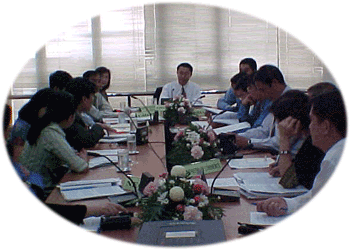
The informal meeting
with CLMV countries was held on 6 March 2002 as part of the workshop
on "e-ASEAN Implementation" organized jointly by the Department
of Business Economics,
Ministry of Commerce and the e-ASEAN Coordination Center.
The meeting was attended by delegates from CLMV countries namely:- Cambodia,
Laos,
Myanmar, Viet Nam and delegates from Thailand which is the host country.
Besides, The
ambassador of the people's republic of China as one of the ASEAN dialogue
partners and the
Office,representatives from the key International agencies: World Bank,
Eu's Program Management
Japan International Cooperation Agency also attended the meeting.
The meeting was chaired by the EAWG Chairman (Dr. Pichet Durongkaveroj)
who gave the
introduction and explained the objective of the meeting that this meeting
was supposed to be the
informal gathering so that members of CLMV countries have opportunity
to express themselves
openly and share information on the situation of ICT development in each
country, their needs on
capacity building, how to further enhance cooperation among ASEAN members,
how to improve
the effective implementation of e-ASEAN Initiative for mutually benefits.
This information sharing
session would provide opportunity for the EAWG Chairman to facilitate
and help resolve the
problems and obstacles as much as possible.
Sharing
the status of ICT development
The discussion started with a briefing among members sharing the status
of ICT development in
order to learn from each other the experiences as well as obstacles they
encounter so that their diverse
capacity building needs can be realized.
Thailand
As the host country, the EAWG Chairman briefed Thailand's experience in
the ICT
development that Thailand is now embarking on 2 phases of ICT development.
First, Thailand has
launched the National IT Plan for 2000-2010. The basic guidelines are
to
use IT as an instrument to bring the country to the knowledge-based economy.
The goal of IT
development is, in fact, not for the sake of IT itself but for the economic
and social development
through IT. There are 3 main components of concerns, namely: the Human
Capacity Building;
The Innovation; and the Information Technology Development.
In translating the objectives into actions,
the plan focuses on 5 IT issues:- e-Government;
e-Industry; e-Commerce; e-Society; and e-education. The National Information
and Technology
Committee has been set up and now chaired by the Deputy Prime Minister
since it is recognized that
IT is a multi-ministry and cross-cutting issue. The government has also
endorsed different
sub-committees to work in details regarding those specific issues. The
concern over digital divide is
addressed under the issue of e-Society by which key measures such as "Telecenter"
has been
investigated in order to make full utilization of the telecommunication
infrastructure to disperse the
knowledge to communities and villages so that villagers can make use of
IT as a self-help mechanism.
Second, Thailand is during
the transition period of liberalizing telecommunication sector. Transfer
and operator law and other related laws as well as the independent regulator
are being developed to
facilitate the privatization process. Thailand's telecommunication market
is planned to be opened up
by the year 2006 in accordance with the commitment under WTO rules. At
the same time, in order to
strengthen the telecom market, key related laws are under the development
process including cyber-
crime law, consumer protection law, etc.
Cambodia
After the 34th AEM, Cambodia set up the e-ASEAN working Group in Cambodia
but it
is still going in a slow process. Since 2001, it has also established
the National ICT Development
Association (NIDA) led by the Prime Minister to draft the ICT Master Plan
as well as the establishment
of the Government Administration Information System (GAIS). The ICT Master
Plan focused on 4
areas:- e-Government; e-Residence; e-Real Estate; and e-Development. The
challenges facing Cambodia
now are the issues of ICT Human resources Development; and the problem
of know-how because of
low technical skills.
Laos
The ICT development in Laos is at the very first stage. The country is
encountering many
problems such as lack of infrastructure; lack of skilled human resources,
and lack of legal framework
etc. There is no ICT curriculum at the primary and secondary education.
There is no professional IT in
the universities. Only private sector organizations offered basic training
in ICT. However, The public
awareness is rather very high. Some ministries are planning to set up
the intranet. The number of
Internet caf?s is increasing very fast. Unfortunately, there is no ICT
master plan yet. The issue of
e-commerce is very new. There is much need in the development of cyber
law for the e-ASEAN
Initiative.
Myanmar
The government now recognizes that ICT is the key for economic and social
development.
Myanmar is under the process of ICT development. The Internet Task Force
has been set up. The ICT
Park has been established in order to concentrate those infrastructures
relating ICT in one place. The
infrastructure and e-Commerce laws are being drafted. However, the cyber
law is not going to be
materialized very soon and Myanmar will need technical assistance on this
issue. Most serious problem
Myanmar faces is the qualification of human resources in ICT.
Viet
Nam The Viet Nam Master Plan for IT consists of
5 key programs, namely: - human resource
development in ICT; upgrading of infrastructure; the development of software
industry; The development
of hardware and the acceleration of the development in ICT. In trying
to attract foreign investment in
ICT, Viet Nam has provided incentives for investors such as tax preference.
One of the challenges that
can be seen in the future is how to develop ICT in Viet Nam particularly
the human resource development.
The development of IT needs experts while the production of IT manpower
from the universities in
the country can not meet the demands from the industries due to the low
quality of education and
training in ICT. The other challenges are the very high cost of Internet
usage which has resulted in the
low utilization of the Internet as well as the lack of laws and regulations
in ICT.
Regarding the organization
in charge, now the IT issue is handled under 2 ministries:-
the telecommunication and the environment ministries but a specific IT
ministry is aimed to be
established like in the case of Thailand in the near future.
In
conclusion there are some common factors/characteristics
that New ASEAN members share in
particular:- the lack of skilled human resources/experts in the area of
ICT; the insufficient distribution
of basic infrastructure which causes the big gap of digital divide as
well as the opportunity to boost
the domestic demand on ICT consumption; high cost of Internet usage; the
lack of experts in ICT
laws development while the privatization of ICT industries are under the
process; It should be noted
in addition that every country puts emphasis on the aim to promote software
ICT industry in the very
near future.
Concerns
raised among members
The CLMV countries had opportunity to express their concerns on the issue
of ICT development and
the meeting exchanged and shared their views on how to resolve the problems
as followed:-
 The impact of liberalization The great concerns of CLMV
countries are the
The impact of liberalization The great concerns of CLMV
countries are the
negative impact of the liberalization for fear that the quick liberalization
in ICT when the countries are
not well prepared will destroy the domestic industries and the overall
economic growth of the countries.
However, the meeting shared the experience witnessed in both the developed
and developing countries
that trade liberalization will eventually benefit the countries in the
long run since the lower prices of ICT
products will encourage the consumption of IT and the people and society
as a whole will finally be
enriched. The knowledgeable people and workforce is the key for enhancing
competitiveness of the
country in the world of globalization. At the same time, free flow of
trade is directly linked to direct
foreign investment which usually comes with technology transfer. The point
is how well the country
can prepare for the adverse affects during the transition period. The
government should decide how to
position the country and invent appropriate policy measures to take care
of the industries or sectors it
would like them to be replenished.
Concerns over the issues of the development
of e-Commerce The meeting
exchanged view on the issue of e-Commerce and the precautions are raised
on the 2 key concerns in
the process of e-Commerce development. First, the integration of sales
and services. Second, the
volume of products offered through the Internet and speed of sending the
products since buyers are
always curious to get their products as soon as possible with their satisfaction
being guaranteed. In this
respect, the CLMV as much as other countries should be aware that the
setting up of website together
with the access to the Internet is only the first and initial step of
achievement in promoting e-commerce.
Concerns
over the promotion of Internet usage The members shared
experiences among each other and agreed that the most crucial step in
promoting Internet for the
development of knowledge-based economy is not only providing infrastructure
so that people can get
access to the service but the content itself which should be developed
appropriately with the country's
stage of development. The development of local content and language software
includes the issue of
language software development are still the big problems in many of CLMV
countries.
Concerns over the effective implementation
of e-ASEAN Initiative among
CLMV countries Considering the high expectation on effective
participation of e-ASEAN Initiative
among CLMV countries, the questions arose when there is still a diverse
stage of development and
there seems to be insufficient financial support to run the projects.
The solution from the sharing showed
that, in fact, the real cause of the problem is not the money but it is
how to manage the use of scarce
resources both in ASEAN as much as in each country. The key point is the
lack of a good package of
projects to propose to the possible and available funding sources. There
still seems to be no flagship
to agree upon among AEAN themselves. This situation reaffirms the need
for the outcome of the
strategic review of e-ASEAN Work Program so that projects/ activities
are streamlined and prioritized
as well as the need for the more effective management. With respect to
the latter issue, the decision
had been made to appoint the country project coordinator to manage the
e-ASEAN Initiative in each
country on a full time basis and build network among ASEAN members. If
these mechanisms are not
truly implemented, the effective implementation of e-ASEAN Initiative
will not be able to be expected.
Besides, in considering the implementation of e-ASEAN Initiative, the
IAI work program with respect
to ICT development has to be taken into account within the same package
of e-ASEAN activities in
order to avoid duplication. The capacity building needs should reflect
the felt needs of each CLMV
countries which are different regarding their different circumstance and
stage of development. However,
the same application for all is that a comprehensive plan is needed and
have to be implemented in the
long term process.
Concerns over the participation of the private
sector The meeting agreed that
private sector plays a key role in propelling the economic growth of the
countries and therefore the
private sector involvement in e-ASEAN projects is crucial to realize their
impacts on the economy.
However, the more important points are how to sustain its role especially
from the proposed projects
under the management of the Task Force in the long run and how those existing
projects are useful for
the ASEAN-wide purposes.
Framework
for closer coordination
The meeting discussed
and shared views on how to develop better and closer coordination in order
to bridge the digital divide and to achieve the goals of e-ASEAN Framework
Agreement.
Models and approaches for cooperation in ICT
development: Taking into
account the concerns CLMV have addressed above, the meeting agreed that
the synergy for closer
cooperation to bridge the digital divide is needed. Besides bilateral
approach, there are some other
models worth exploring such as:-
 Extending deeper cooperation among ASEAN members to complement
the disadvantage within
Extending deeper cooperation among ASEAN members to complement
the disadvantage within
one country A good example that should be raised here is the possibility
of cooperation between
Myanmar and Thailand in the development of ICT software industry. Since
Myanmar is rich in English
qualification of human resource, while Thailand has larger ICT market
both domestic and potential
export market, the joint venture investment in software industry can be
experiment exploiting the
strength of Myanmar human resource to capture the Thai market. Regarding
the visible and indispensable
tougher competition between ASEAN and the outsider, it is therefore ideal
that CLMV and ASEAN
countries seek closer cooperation and move forward as a team or a group
so that some strength can
be explored from that approach.
Extending the cooperation beyond ASEAN +3 approach Regarding
the advantages and
disadvantages of
the ASEAN as a group comparing to other regions/ countries, it would be
rational to explore
deeper and closer cooperation beyond the group of ASEAN +3. The
possibilities are as
follows:-
๐
The cooperation with India :- Since by the end of this year ASEAN
is going to extend
the relationship with India, it is therefore timely to initiate appropriate
cooperative projects
with India regarding ICT products. Taking into account the advantage of
India in its
progress in software industry development, India should be able to organize
the commercial
training course on ICT as well as the joint investment in software industry
through soft-loan
lending or outsourcing of fund. There should also be possibility to invite
India to join the
EAWG meeting indicating the members' interest in having his presence in
ASEAN together
with other dialogue partners.
๐
The cooperation with CER group:- As a matter of fact, the ASEAN has extended
its
relationship with the CER group regarding general economic and social
issues through the
coordination of Ministry of Foreign Affair except in the area of e-ASEAN
Initiative. There is
also plenty of rooms to seek cooperation in the area of ICT development.
The point is only
how can we streamline the priorities of our needs as a group so that the
cooperation and
technical assistance be focused and fruitful.
Multilateral approach and ASEAN-Wide projects:- Besides the concerns of
individual member's
interest in ICT development, e.g., the specific relationship between the
donor and the recipient such as
Thailand and any specific CLMV, emphasis should also be placed on the
"ASEAN-Wide" cooperation
by extending those specific projects/ programs to the rest of ASEAN members.
For example, the
setting up of consortium or network on ASEAN SchoolNets. These ASEAN-Wide
activities seem to
have a longer and sustainable impact on the ASEAN societies as a whole
in enhancing the region's
competitiveness while bridging the digital divide within the region.
Leadership is important the
meeting agreed that there may be need to identify the
key leaders and organize a special training course for them in order to
try to convince them the importance
of ICT sector and its development in enhancing the country's competitiveness
Roles
of International agencies and Dialogue partners
The meeting had
the opportunity to exchange views with the representatives from key international
agencies and the dialogue partners on the possibilities to seek technical
assistance from them and pool
scarce resources.
China The ambassador
of China kindly joined the meeting and addressed China's
great concern on the issue of ICT development especially for CLMV countries.
According to H.E.
ambassador, China attaches importance to EAWG+3 meeting mechanism and
is conducting due steps
and pragmatic implementation to broaden the scope of cooperation for the
brighter future of ASEAN
and China.
The Program management office of
the European Union (PMO) The European
Union (EU) launched the Asia IT&C program in 1999 in order to co-finance
mutually beneficial
partnerships in ICT between Europe and Asia. The main objective is to
promote cooperation between
non-profit organizations in Europe and Asia particularly SMEs in 8 areas
/sectors with application of
ICT, namely:- society, e-commerce, education, transport, health, agriculture,
tourism, i-manufacturing.
Japan International Cooperation Agency(JICA)
Regarding the issue of ICT,
JICA provides both hard and soft part of technical assistance. The hard
part are for example:- the
J-net, long distance learning program, sattlelite establishment center.
Among the ASEAN countries,
in the past ,JICA assistance concentrated in the Philippines and Thailand.
Now it is planning to move
on to CLMV countries in due course such as in the area of computer and
teaching machine for human
resource development program. Among the CLMV countries, now JICA center
has been established
in Laos, Viet Nam, Myanmar and Cambodia.
World Bank The Bank
provides financial support (both lending and non-lending)
for projects under ICT sector under the administration of the multi-donor
Information for Development
Grants (infoDev), Public-Private Information Advisory Facility (PPIAF)
programs, bilateral trust funds,
as well as the Bank Institutional Development Fund (IDF). The Bank's assistance
is not supposed to be
tailored to the recipients but depends on their own drives or needs.
In
summary There is opportunity for CLMV as well as other
ASEAN countries to seek financial support
in the area of ICT development. It is more the matter of having the synergy
and the concrete project
proposals to apply for it. It is also reminded that all the international
agencies have their own rules and
regulations and need proper procedures of applications for the assistance.
|