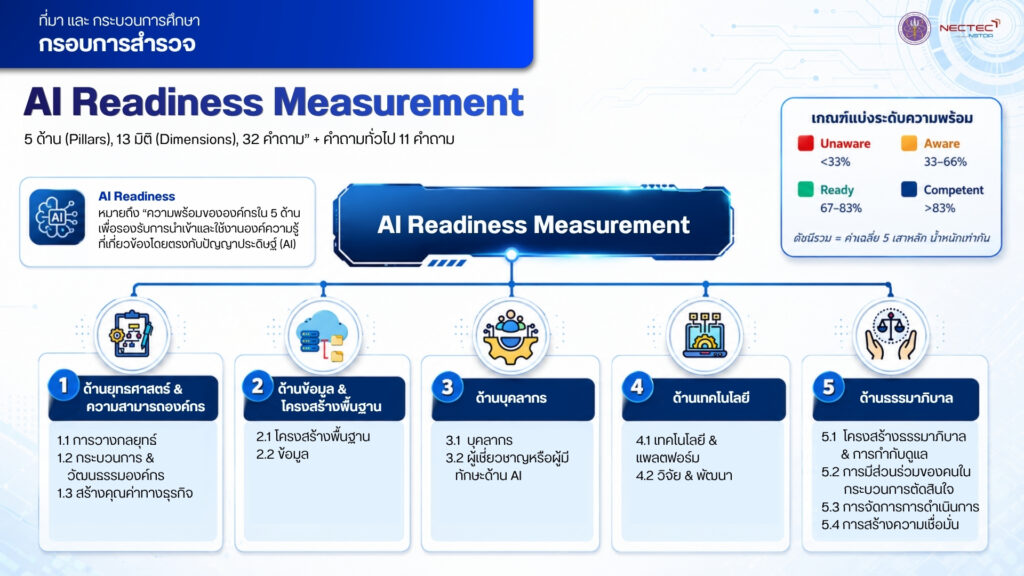
September 3, 2026 — The National Science and Technology Development Agency (NSTDA), through the National Electronics and Computer Technology Center (NECTEC), today released the results of the 2026 Organization AI Readiness Survey of Thailand. The survey covered 574 public- and private-sector organizations across 10 target industry groups, in line with the National AI Action Plan, and was designed to capture the real-world state of AI adoption in organizations as well as their readiness across several dimensions — strategy, data and infrastructure, personnel, technology, and governance. The findings will inform the design of measures to promote AI use in Thailand in a way that is effective, cost-efficient, and responsible.
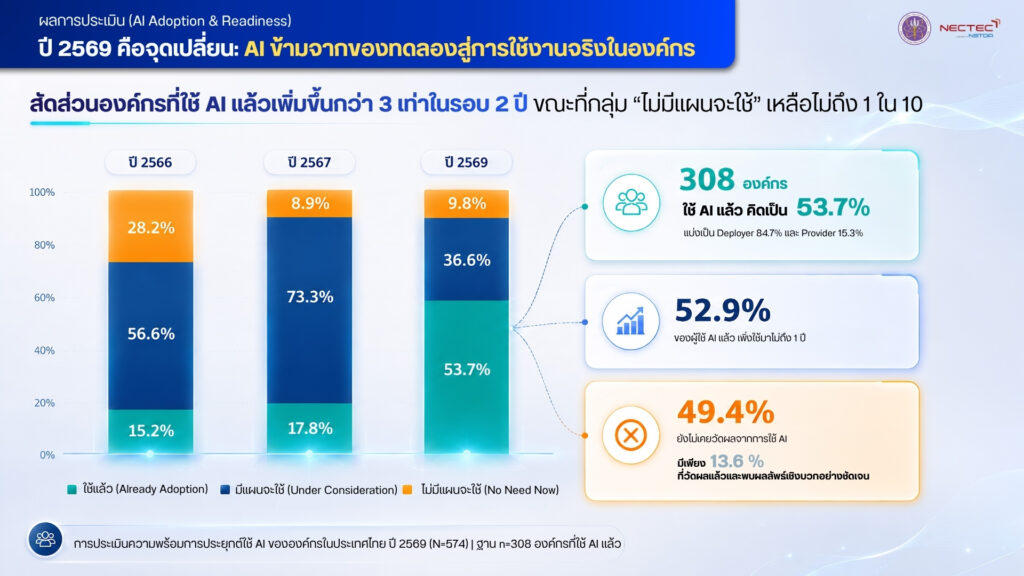
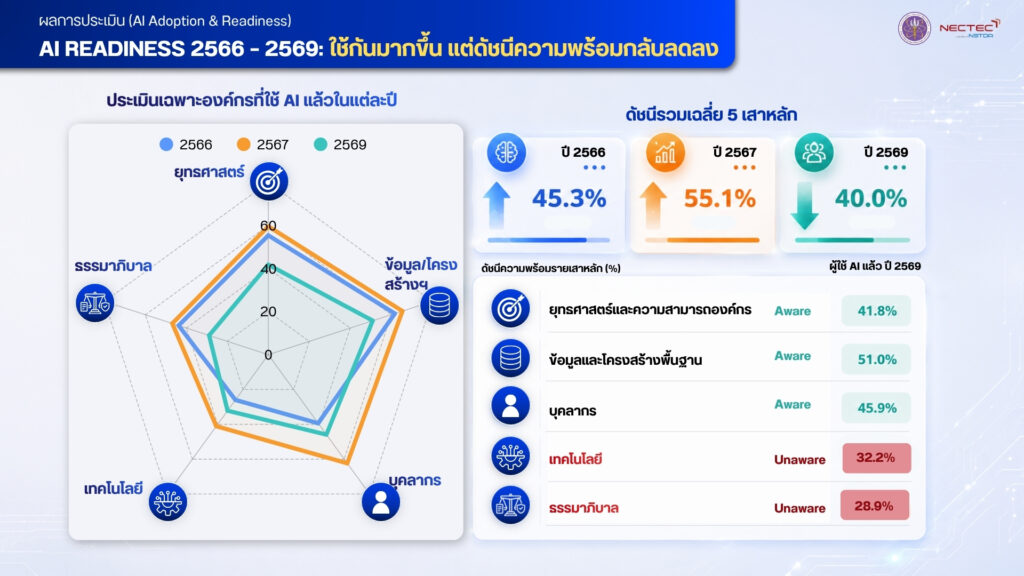
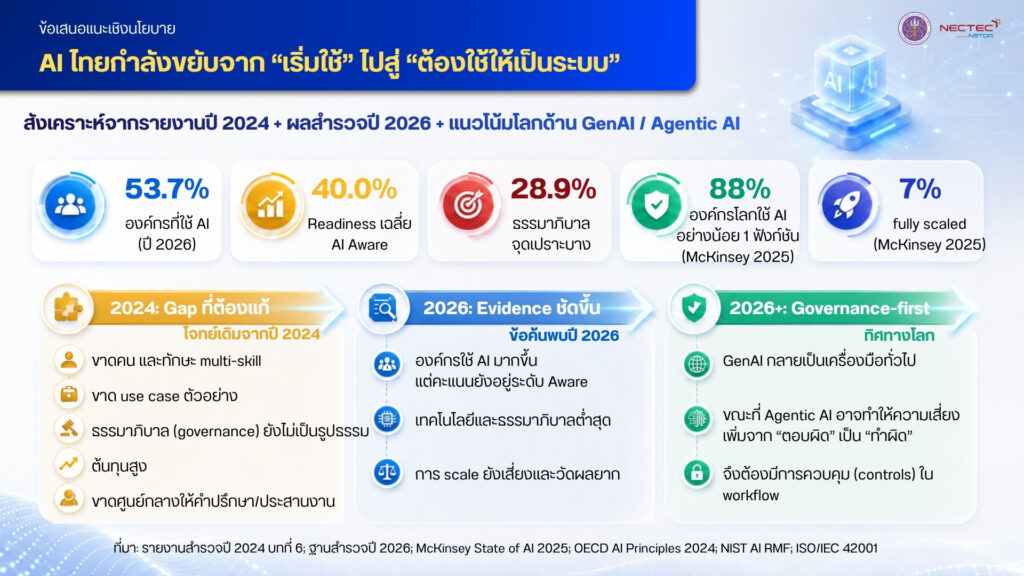
The survey found that 53.7% of organizations have already adopted AI, 36.6% plan to use it, and only 9.8% do not yet have plans to use AI. This reflects that AI is rapidly moving into the mainstream of Thai organizations, as shown by the share of organizations that have adopted AI, which tripled between 2024 and 2026. However, when looking only at the 308 organizations that have started using AI, the average readiness score is 40.0%, corresponding to the “AI Aware” level — meaning organizations are aware of AI and have begun using it, but still need to build substantially more supporting systems before they can scale up use fully. The decline in the readiness index from 55.1% in 2024 is explained by the expansion of the user base from 103 organizations to 308 organizations, which brought many newly-starting organizations into the calculation base. This does not represent a decline in readiness, but rather reflects that AI adoption is spreading more broadly.
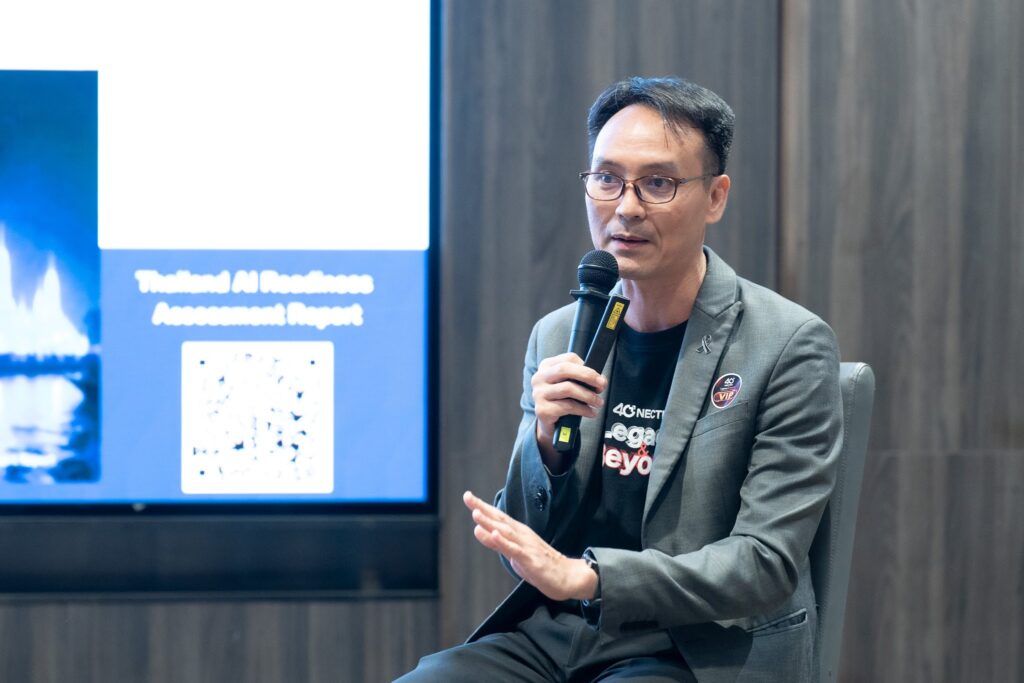
Dr. Chai Wutiwiwatchai, Executive Director of the National Electronics and Computer Technology Center, said: “This year’s survey shows that Thailand’s challenge is not merely about getting organizations to start using AI, but helping them choose AI applications suited to their specific needs, equip themselves with ready data and personnel, measure results, and put in place governance mechanisms that build trust — especially at a time when Generative AI and Agentic AI are rapidly changing how organizations work.”
The survey assessed organizations across five readiness dimensions: (1) strategy and organizational capability, (2) data and infrastructure, (3) personnel, (4) technology, and (5) governance. It found that data and infrastructure scored highest at 51.0%, followed by personnel at 45.9% and strategy and organizational capability at 41.8%, while technology stood at 32.2% and governance was lowest at 28.9%. This clear pattern shows that organizations’ strengths lie in what can be acquired through investment, while the gaps lie in what must be built through internal processes over time. While 64.0% of organizations have data storage systems in place, only 40.8% have data of a quality ready for AI use, and 51.6% still lack an AI architecture to support system integration and scale-up. In short, Thai organizations increasingly have the data foundations and people needed to support AI use, but gaps remain in advancing technology, managing risk, ensuring human oversight, and translating AI governance principles into concrete organizational processes.
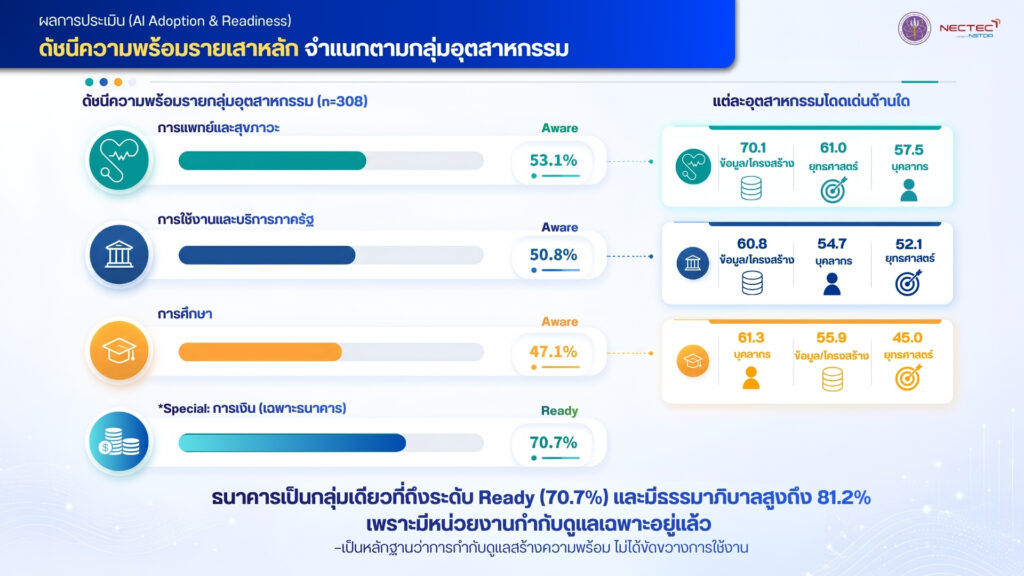
AI use and readiness by industry: the manufacturing sector recorded the highest level of AI use, followed by education. In terms of readiness, however, the healthcare, public-sector services, and education sectors were the most ready, with average scores of 53.1%, 50.8%, and 47.1% respectively, while the energy and environment sector was the least ready. The gap between the highest- and lowest-scoring groups reached 33.5 points, clearly reflecting differences in readiness across sectors and indicating that government measures should be tailored to the context and readiness level of each industry rather than applying a one-size-fits-all approach. Within the financial sector, when split into “banks” and “non-bank financial institutions” (which include asset management firms, non-bank operators, securities companies, and insurers), a wide gap emerges: banks recorded an average readiness score of 70.7%, the only group in the survey to reach the “Ready” level, with a governance score as high as 81.2%, while non-bank financial institutions averaged only 22.8%. This gap is consistent with the fact that the banking sector already has regulatory oversight bodies and established data practices in place, underscoring how a clear regulatory framework can genuinely raise organizational readiness rather than acting as a barrier to adoption.
By organization size, 67.2% of large organizations have adopted AI, compared with 48.5% of medium-sized and 43.8% of small organizations. Yet readiness scores across all size groups remained at the “Aware” level (large organizations 41.1%, small organizations 35.9%, and medium-sized organizations 34.0%, with the latter two close to each other). Meanwhile, the group with unspecified size — mostly government agencies and educational institutions whose size cannot be classified under Department of Business Development criteria — scored 49.2%, the highest of all groups, consistent with this group already operating under civil-service regulations. Governance remains the weakest dimension across every size group, including large organizations with substantial resources, showing that “access to tools” alone is not enough. Government support is needed to help organizations — especially SMEs — identify worthwhile use cases, prepare data and processes, develop skills, and measure the returns from using AI.
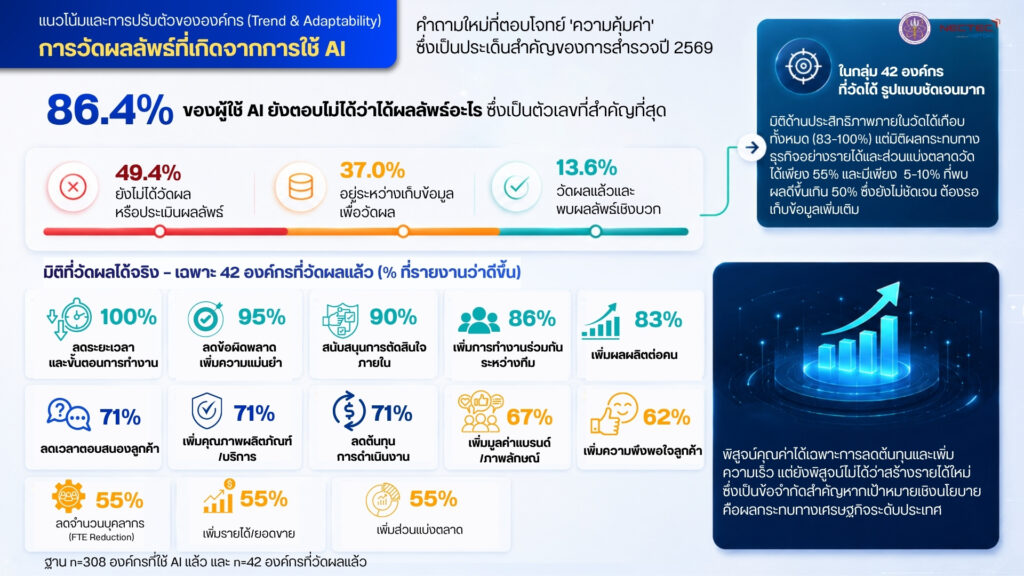
The survey also points to several policy gaps. Most notably, 86.4% of organizations already using AI still cannot say what results they have achieved from it (49.4% have never measured results, and 37.0% are still in the process of collecting data); only 13.6% have measured results and found clear positive outcomes. Value has been clearly demonstrated only in reducing costs and time spent on work, while impact on revenue growth or market share remains unproven.
“GenAI Is Widespread, While Agentic AI Is Beginning to Enter Workflows”
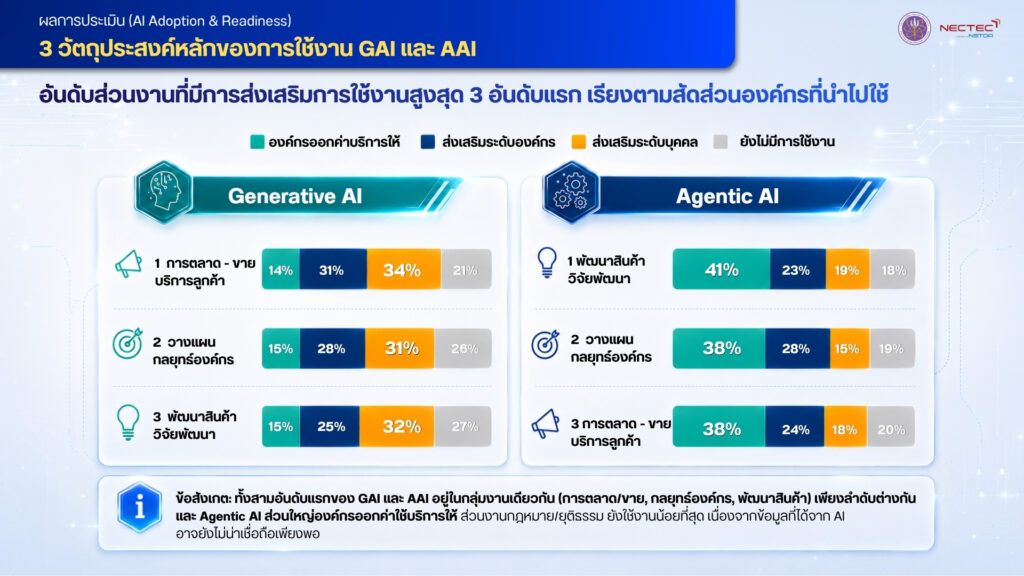
Among organizations that have started using AI, Generative AI use is most common in marketing, sales, and customer service (74.7%), corporate strategy (69.8%), and product/service development or R&D (68.8%). Agentic AI — which can take on goals, plan, make decisions, and carry out multi-step tasks autonomously — is still at an early stage, with the highest use found in product development/R&D (21.4%), corporate strategy (20.8%), and marketing, sales, and customer service (20.5%). Currently, 26.0% of organizations that use AI have begun using Agentic AI — a share still small enough that shared guidelines could realistically be put in place in time. This makes it a suitable moment to design human oversight mechanisms before adoption expands more broadly.
Organizations Need a “Regulatory Framework + Advisory Support + Executive Knowledge” to Accelerate AI Adoption
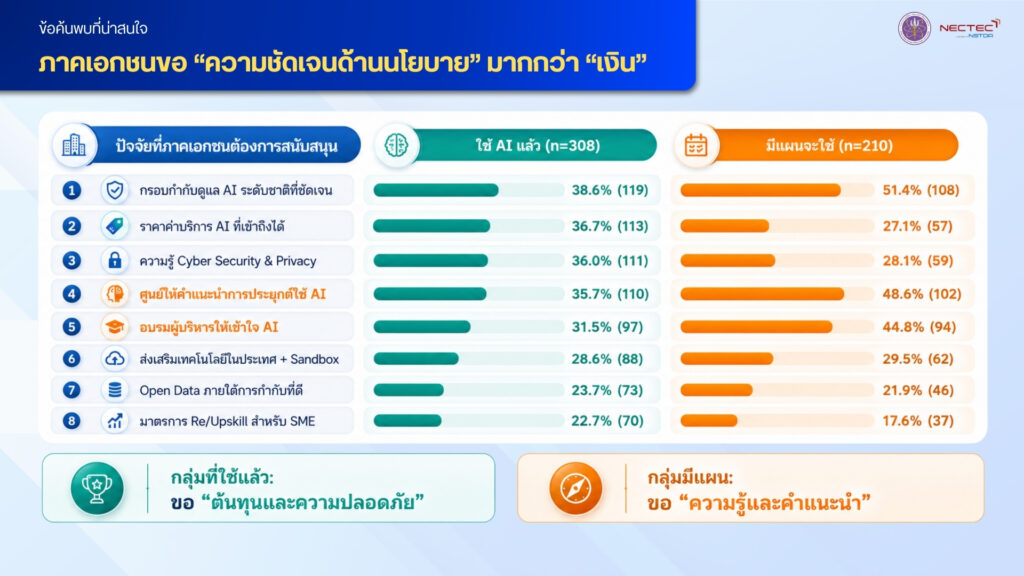
The survey also found that what organizations need is not simply budget, but a support system that reduces uncertainty in adopting AI. Key priorities include a clear national AI governance framework (laws, standards, and guidelines) that allows organizations to set internal policies and manage AI-related risk, as well as AI advisory centers and executive training to build understanding of the benefits, value, risks, and investment decision-making involved in AI. Among organizations that have not yet started using AI, this need is even more pronounced: more than half (51.4%) cited a clear regulatory framework as their top priority, and 48.6% wanted an advisory center — both roughly 13 points higher than among organizations already using AI. This suggests that many organizations are ready to begin using AI but are waiting for greater clarity before deciding.
Compared with the 2024 survey, which had already identified gaps in personnel, the lack of concrete use cases and governance advisors, and the cost of accessing technology — and had proposed directions on AI Workforce, AI Consultancy & Services, AI Governance & Ethics, and Cost & Efficiency — these core challenges remain highly relevant. However, the 2026 context is more urgent, driven by the spread of Generative AI and the emergence of Agentic AI.
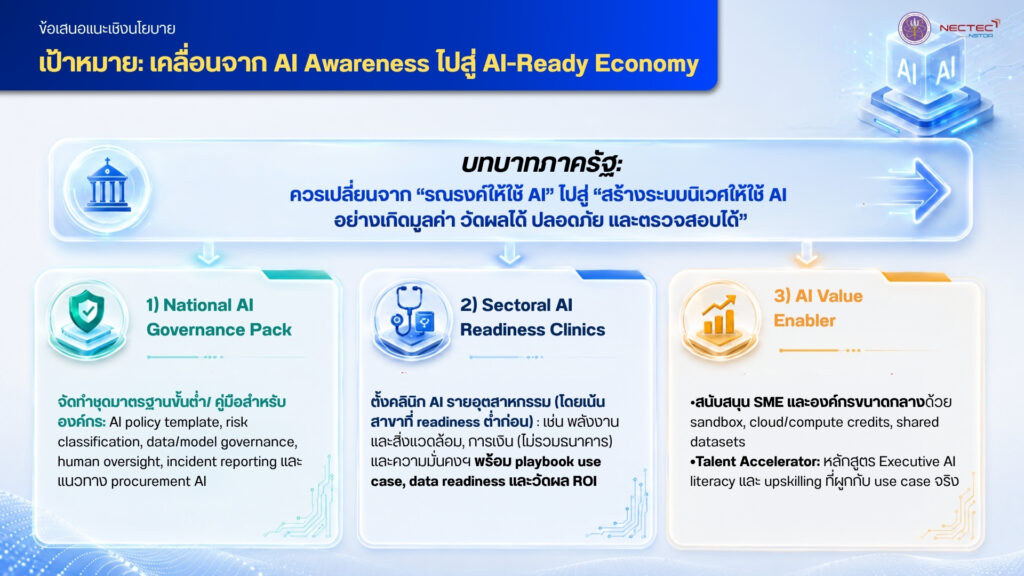
Based on the survey findings, three urgent policy measures are proposed for the government and relevant agencies to pursue:
- National AI Governance Pack — Develop a basic standard toolkit for organizations, including an AI policy template, risk classification, data/model governance, human oversight, incident reporting, and AI procurement guidelines, along with sector-specific guidance for industries with high risk or impact.
- Sectoral AI Readiness Clinics — Establish industry-specific AI clinics, prioritizing sectors with lower readiness such as energy and environment, finance (excluding banks), and security, together with use-case playbooks, data readiness preparation, and ROI measurement before scaling to other industries.
- AI Value Enabler — Support SMEs and medium-sized organizations with sandboxes, cloud/compute credits, and shared datasets, along with a talent accelerator offering executive AI literacy and upskilling courses tied to real use cases, enabling organizations to use AI safely while creating value.
Dr. Chai Wutiwiwatchai concluded: “Thailand’s AI adoption has grown threefold in just two years. Future measures must gauge success by actual use and the results organizations achieve — not merely by the number of organizations using AI or the number of courses and trainees. The country’s goal should be to help organizations move from awareness and experimentation toward AI use that creates real value — productivity, business value, and public value — within an appropriate governance framework.”
Download the documents and explore the Results Dashboard for the Thailand AI Readiness Assessment 2026 at https://www.ai.in.th/thailand-ai-readiness-assessment-2026/